


Our President met with teachers and mentors and outlined new initiatives in the education sector.
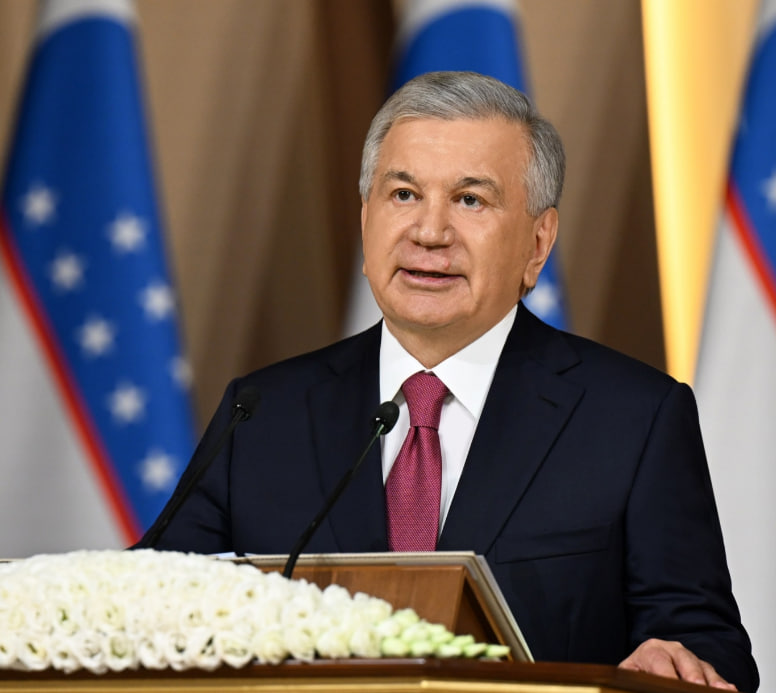
Ahead of Teachers and Mentors Day, President Shavkat Mirziyoyev held a meeting with educators.
After congratulating all teachers and mentors on their professional holiday, the Head of State highlighted their vital role in nurturing the younger generation.
"A teacher is an ocean of love and care; a teacher is a source of goodness; a teacher is the sun of enlightenment!" the President said.
Today, artificial intelligence is transforming approaches to learning and work. Yet, no technology can reach a child's heart the way a teacher does, nor instill in them a sense of love for the Motherland and a sense of responsibility. In this regard, the Head of State expressed gratitude to the educators who have dedicated their lives to the upbringing and development of the younger generation.
During the meeting, state awards were presented to a group of representatives from the fields of education and science. The recipients included foreign partners contributing to the development of education. Furthermore, a proposal was made to establish a special state award named after Abdulla Avloni for outstanding educators at all levels of the education system, with the first presentation scheduled for next year's professional holiday.
It was emphasized that the development of education is a crucial element in building a New Uzbekistan. Over the past decade, kindergarten places for 1.8 million children and school places for 1.5 million students have been created, and more than 10,000 educational institutions have been modernized and given a contemporary look. At the same time, it was noted that today, the content and quality of instruction are more important than the development of physical infrastructure.
"We brought our children back from the cotton fields to their school desks, and our teachers back to the educational process," the Head of State said.
To this end, the development of a new generation of textbooks began in 2018. International best practices were studied, and textbooks up to the 8th-grade level were updated. This year alone, 324 textbooks have been updated with the participation of over 400 specialists. These textbooks aim to foster national values, a sense of responsibility toward nature, digital and financial literacy, and skills in independent and critical thinking among children. The process of updating textbooks for senior grades is scheduled for completion by 2030.
The results of these reforms are reflected in student achievements. In the PISA rankings, 15-year-old students climbed 32 places in natural sciences, securing 48th place. This year alone, young people won 228 medals at prestigious international Olympiads. The number of students obtaining certificates in foreign languages and specific subjects while still in school has reached 100,000.
Support provided to educators is also yielding results. Over the past five years, the number of teachers holding international and national certificates has risen from 29,000 to 143,000, while the shortage of teaching staff in schools has been reduced threefold. Today, 40,000 teachers earn a salary of $1,000, and another 1,500 educators earn over $2,000. A proposal has been made to expand the "Teacher of the Year" competition to include kindergarten educators and vocational college instructors.
Addressing future objectives, the President of Uzbekistan emphasized that school graduates should enter adulthood equipped with a profession and foreign language proficiency. School principals will be granted additional authority in this area, and necessary conditions will be created for entrepreneurs willing to collaborate. A commission will be established to address the vocational training of school-age youth and ensure continuity across educational levels. New decisions regarding these areas will be announced within three months. To foster the technological development of the economy, special emphasis will be placed on the in-depth study of mathematics, physics, chemistry, and biology. In classes with more than 25 students, instruction in these subjects will be conducted in two separate groups. Teachers holding a national certificate will receive a 50 percent salary supplement. Each year, leading teachers from 208 districts and cities will be awarded prizes, and one thousand educators will undergo internships abroad. Teachers who prepare winners of academic Olympiads will be directly granted the highest qualification category.
Subject-specific Olympiads will also be organized for primary school students. Starting next year, winners of the competition for 4th-grade students will be awarded computers, while their teachers will receive cash prizes based on the competition stage. Beginning in the new academic year, mathematics, computer science, and natural sciences will be taught entirely in English in 100 schools. Teachers and preschool preparatory group educators participating in this project will receive a 100 percent salary supplement.
A "quality index" will be introduced to evaluate school performance. Educational institutions will be categorized based on learning outcomes and teacher capabilities. Leading schools that assist other institutions in moving up to a higher category will receive a 30% salary supplement for their teaching staff. Regarding teacher training, mandatory month-long courses will be replaced by professional development vouchers; teachers will be able to choose their own training programs—ranging from 18 to 72 hours—based on their individual performance.
Measures to support private schools have also been announced in response to the growing demand for school places. Concessional loans and subsidies will be provided for the establishment of private schools in 52 districts where the education system is under high pressure. Vacant state-owned buildings will be leased to private schools rent-free for ten years, and half of the costs associated with international accreditation will be covered. For parents with children in private schools, the tax-exempt income threshold will be doubled.
Greater emphasis will be placed on creating an inclusive educational environment for children with special needs. Over the past two years, the number of inclusive schools has increased nearly fivefold, reaching 3,591. The model of the multifunctional inclusive resource school—first launched in Tashkent—will be implemented in the Khorezm, Jizzakh, and Samarkand regions by the end of the year, and rolled out across all regions of the country over the next two years.
It was emphasized that kindergartens should serve as environments where a child's talents can flourish. Some 180,000 preschool educators and teachers are undergoing training based on a program that draws on best international practices and focuses on play-based learning. By the end of the year, this program will be implemented in all of the country's more than 38,000 kindergartens. State-run kindergartens will be equipped with modern facilities under a three-year program.
To support working mothers, starting January 1 of next year, the state budget will cover the costs of childcare for women whose children (aged 2–3) are enrolled in family-based kindergartens. Opportunities for educators to pursue higher education while continuing to work will be expanded; starting the new academic year, the duration of study at pedagogical universities for them will be reduced from four years to three. Assistant educators with at least five years of experience in a kindergarten will also be eligible for this opportunity.
In the vocational education sector, international programs have been implemented in 104 technical colleges over the past two years. Partnerships between these colleges and 25,000 enterprises have enabled over 100,000 young people to earn an income while studying. Students mastering trades through dual education programs receive a monthly stipend of up to 1.3 million soums. Starting next year, vocational instructors holding international professional certification will receive a 50 percent salary supplement, and 500 instructors will undergo annual internships abroad.
The inaugural "Creators of New Uzbekistan" vocational skills competition attracted 170,000 students. The competition will become an annual event, and the most outstanding participants will undergo training for the WorldSkills competition scheduled to take place in Tokyo in 2028. Tax and land-use incentives will be offered for the establishment of private technical colleges. In such institutions—which train personnel for priority sectors—half of the students will study under state grants. Support will also be provided for introducing international educational programs and equipping laboratories. Turning to the subject of higher education, the Head of State noted that the number of university students in the country has reached 1.6 million, with seven institutions appearing in international rankings across 17 subject areas. At the same time, the President criticized the content of university textbooks and the quality of specialist training, noting that they do not currently fully meet modern requirements. Engineering and medical universities must step up efforts to create new teaching materials in modern fields and to translate and adapt leading foreign educational publications.
The accountability of university rectors regarding the quality and outcomes of education will be increased. Two-thirds of the members of state university supervisory boards will be drawn from the private sector and foreign universities. These boards will revise curricula based on labor market demands and oversee the annual development of at least 50 textbooks. Graduation projects and research activities will be geared toward solving practical challenges facing various economic sectors.
A directive has been issued to expand—based on international standards—national educational programs within universities that will gain global recognition. Starting next year, the models successfully implemented at Inha University and Tashkent Institute of Architecture and Civil Engineering will be adopted by another 20 universities.
To this end, their management systems will be adapted, and dedicated structures will be established to oversee the implementation of international programs.
The meeting also addressed a signed decree on developing dual education in the higher education sector based on the "enterprise–university–targeted personnel" model. Starting next year, the system will be implemented in 75 universities, and by 2028, it will extend to all universities across the country. Enterprises will submit requests for specialist training based on their specific needs, with candidates selected through interviews. The state will subsidize half of the employed student's wages. Students demonstrating strong performance in both work and studies will be eligible for state-funded grants starting from their second year.
Furthermore, mentors assigned to students at enterprises will receive incentives, and students will be reimbursed for housing rental costs where necessary. Universities and partner enterprises that demonstrate excellence in organizing dual education programs will be rewarded. Half of the award received by the university will be allocated to the teaching staff who contributed to the initiative.
The Head of State also set the goal of attracting branches of 300 of the world's leading universities to the country. Private universities that open branches of prestigious foreign institutions will receive partial reimbursement for expenses related to setting up laboratories, purchasing equipment, using the brand, and developing campuses. Priority will be given to fields such as engineering, agriculture and water management, energy, artificial intelligence, and medicine.
The Head of State also set the goal of attracting branches of 300 of the world's leading universities to the country. Private universities that open branches of prestigious foreign institutions under franchise agreements will be reimbursed for a portion of the costs associated with establishing laboratories, acquiring equipment, using the brand, and developing campuses. Priority areas include engineering, agriculture and water management, energy, artificial intelligence, and medicine.
During the meeting, proposals and initiatives from educators were heard. In closing, the leader of Uzbekistan once again congratulated the teachers on their professional holiday and extended his best wishes.
"To value a teacher is to value not merely a representative of a profession, but the future of an entire nation," said President Shavkat Mirziyoyev.
